

Ever bought something you didn’t plan to, didn’t need, and maybe regretted it afterwards?
Yeah, same. Whether it was a late-night Amazon scroll or a spontaneous coffee machine you swore would change your mornings, impulse spending happens to the best of us.
We’ve all been there, that split-second decision that feels good in the moment but doesn’t align with our goals. The point isn’t to criticize ourselves, but to get curious about why it happens in the first place. Because the truth is: overspending isn’t just about money. It’s about emotions, identity, and brain chemistry.
In this deep dive, we’ll unpack the psychology of spending so you can start making financial choices that feel good long-term, not just in the moment.
Why We Overspend
Let’s get one thing straight: being smart with money doesn’t mean you’re immune to overspending. Plenty of people with spreadsheets, savings goals, and budgeting apps still find themselves making purchases that don’t align with their plans.
Why? Because overspending isn’t always about logic, it’s behavioral, it’s emotional, it’s human.
We spend for more reasons than we admit:
- Retail therapy after a rough week, not because we need a new pair of shoes, but because we crave comfort.
- FOMO-fueled bookings, not for the trip itself but for the feeling of inclusion and belonging.
- Lifestyle creep, not for the luxury, but to match a new version of ourselves we’re trying to live into.
- “Little treats” after a productive day, not out of need but as a way to self-reward.
Behind these moments are powerful internal stories: “I deserve this,” “It’s just one thing,” or “I’ll make up for it next paycheck.”
But these narratives often mask something deeper, stress, comparison, boredom, or the desire to feel in control.
This is where self-awareness becomes a financial superpower.
Because the more you learn to recognize what’s really behind the urge to spend, like emotional exhaustion, peer pressure, or a need for validation, the more empowered you are to pause, reflect, and make a conscious choice instead.
The Psychology of Spending: What Happens in Your Brain
Let’s talk about brain chemistry. Every time you buy something, especially something new, shiny, or on sale, your brain releases dopamine, a feel-good chemical tied to pleasure and reward. Neuroscience research has shown that dopamine surges most during the anticipation of a reward, not just the moment we receive it. (Schultz et al., 1997; Knutson et al., 2001). It’s the same chemical linked to things like eating chocolate or getting likes on social media.
But here’s the twist: studies in neuroscience suggest that we get the biggest dopamine hit not when we receive the reward, but when we anticipate it. That moment right before you hit “add to cart” or swipe your card? That’s when your brain lights up the most.
This anticipation effect explains why online shopping can be so addictive, the build-up, the scrolling, the imagining, the tracking, it all feeds the cycle and marketers know this. That’s why so many brands use countdowns, flash sales, and phrases like only 2 left. These techniques play into scarcity and loss aversion, which are two well-documented behavioral tendencies. As behavioral economists Daniel Kahneman and Amos Tversky demonstrated through their research on loss aversion, we feel the pain of potential loss more strongly than the pleasure of a gain. These are powerful psychological triggers, we are wired to hate the feeling of missing out more than we enjoy gaining something.
It’s not about being weak, it’s about how our brains are wired. When those natural responses collide with modern shopping platforms designed to eliminate friction like saved cards, one-click checkouts, and personalized ads, we get caught in a dopamine loop.
Recognizing the spending high doesn’t mean you’re broken, it means you’re aware and that awareness gives you the power to step out of the cycle.
How Your Environment Trains You to Spend
Spending doesn’t always start with a conscious decision, sometimes it starts with what you see, hear, or feel in your environment.
Maybe it’s that influencer who swears the $42 lip balm is life-changing. Or the strategically placed “Buy One Get One” sign near checkout. Or your own phone, offering a 10% off popup the second you scroll Instagram.
These aren’t accidents. They’re psychological nudges and they’re everywhere.
Retailers and brands design entire environments to trigger spending:
- Color psychology: Bright red tags signal urgency.
- Music tempo: Slower beats make you browse longer.
- Smell and lighting: Warm, cozy setups make you feel safe, nostalgic, and open to spending.
And in the digital world, it’s even more intense. Algorithms show you products you’ve paused on. Email subject lines create urgency. Personalized ads follow you around the internet.
But here’s the thing, your internal environment matters too.
When you’re tired, bored, stressed, or lonely, your brain is more susceptible to these outside prompts. You’re not just seeing a product, you’re seeing a potential mood boost, a small escape, a moment of control.
And that’s when the loop begins. Feel bad, seek comfort, get a dopamine hit, repeat. The more aware you become of this pattern, the easier it gets to interrupt it.
One of the biggest shifts for me was realizing how often I spent from emotion, not intention. I dive into that more in my post Why You Keep Getting Stuck With Money and How I Finally Got Unstuck.
The goal isn’t to avoid spending forever. It’s to build enough awareness that you can tell the difference between spending to soothe and spending to support the life you want.
What Are You Really Buying?
We talk a lot about “impulse spending” or “retail therapy,” but what we’re often doing is something much deeper. It’s emotional spending.
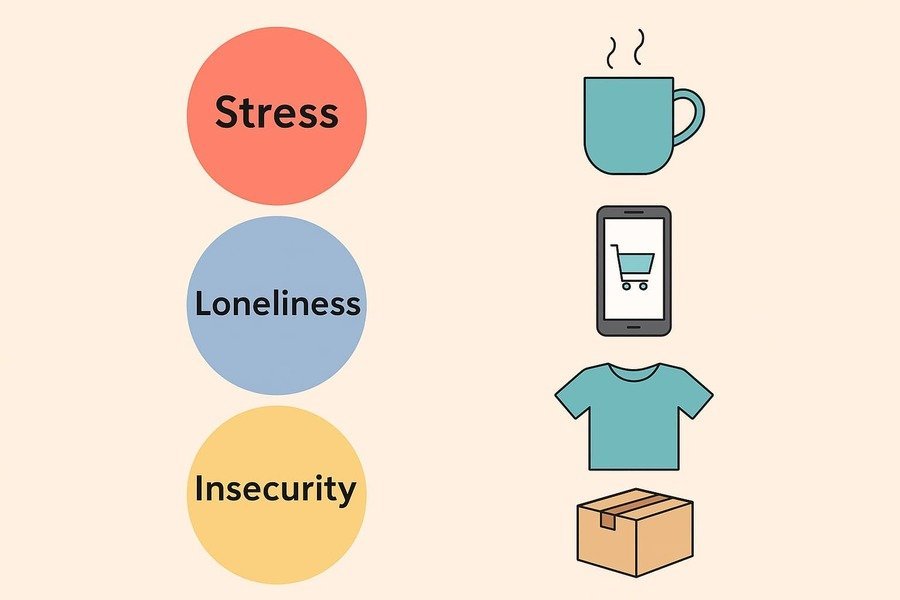
This is when you spend not because you truly need something, but because you’re trying to shift how you feel. Maybe it’s stress, maybe it’s loneliness, maybe it’s a sense of feeling stuck or left behind.
In those moments, you’re not just buying a latte, a new planner, or a pair of sneakers, you’re buying a feeling:
- Comfort
- Control
- Confidence
- Escape
- Validation
Ask yourself: what do I tend to shop for when I’m feeling low?
You might start to notice patterns. Maybe it’s clothes when you’re feeling insecure. Home decor when you’re craving calm. Tech gadgets when you’re avoiding something bigger.
And here’s the thing, it’s not wrong to want those feelings, we all do.
The problem is when we expect our purchases to fix something emotional that they were never designed to fix. That’s how the cycle keeps going. We feel the dip, we spend to boost ourselves, we feel guilty or unfulfilled, and the loop resets. Getting honest about what you’re really buying is one of the most powerful mindset shifts you can make, and it’s something I wish I’d learned way earlier in life. That’s why I included it in 8 Money Habits I Wish I Learned in My Early 20s. Because once you understand your emotional triggers, you can start building habits that actually support your goals, not sabotage them.
How to Break the Habit Without Feeling Deprived
Let’s be real, trying to stop spending altogether usually backfires. It feels like punishment, it makes you crave it more, and it doesn’t actually solve the emotional or environmental triggers that led to the behavior in the first place.
Instead of cutting spending cold turkey, let’s talk about how to create smart friction and build habits that keep you intentional without feeling restricted.
1. Use Wishlists Instead of Carts
Train your brain to delay gratification. When you feel the urge to buy, don’t add it to your cart, add it to a wishlist or note. Sit with it for 24 hours, or better yet, a week. If you still want it and it aligns with your goals, cool. If not, you just saved money and reinforced self-trust.
2. Add Friction to the Buying Process
Make spending slightly harder to give your rational brain time to catch up. Try removing saved cards, disabling one-click checkout, or logging out of shopping apps after each use. That one extra step might be all it takes to break the autopilot cycle.
3. Track Your Mood Before You Shop
Keep a quick notes app or journal. Every time you want to spend, jot down how you’re feeling. Not what you want to buy, how you feel at that moment. You’ll start spotting patterns that reveal whether it’s an emotional urge or a thoughtful decision.
4. Replace the Swipe With Something That Grounds You
When the urge to spend hits, give yourself 10 minutes. In that window, try another soothing activity: a short walk, a playlist you love, a cup of tea, or even writing down what you’re trying to escape. You might still want the thing later, but you’ll be choosing it consciously.
5. Build “Yes Days” Into Your Budget
Bans often lead to binges. Instead, schedule intentional spending days. Knowing you have a built-in moment to treat yourself reduces impulsive purchases and makes the act of spending more joyful, not guilt-filled.
The goal isn’t to say no forever, it’s to build a system where saying “yes” feels like a decision, not a reaction. And that’s what real financial freedom looks like.
You’re Allowed to Spend, But On Purpose
Let’s clear something up: spending isn’t the enemy. Money is a tool and how you use it should align with your values, not with guilt or fear.
You don’t have to feel bad for wanting something nice. You don’t need to justify every expense. What matters is why you’re spending and how it fits into the life you’re building.
Intentional spending means:
- Buying things that genuinely add value or joy
- Aligning purchases with your current priorities (not someone else’s)
- Choosing experiences or items that support growth, rest, or connection
- Avoiding purchases that drain your energy, clutter your space, or delay your goals
Think of spending like casting a vote for the kind of life you want. Every time you spend, you’re reinforcing a priority whether that’s wellness, creativity, relationships, or simplicity.
Here are a few examples of values-aligned spending:
- Investing in therapy or coaching because your mental health matters
- Booking a solo trip because you value exploration and independence
- Paying for a house cleaner so you can reclaim time for your kids or your business
- Subscribing to a quality meal plan because health and ease are top priorities
These aren’t frivolous, they’re purposeful. What matters is that they reflect what you value most.
It also means letting go of the pressure to do it perfectly. Sometimes spending is emotional, sometimes it’s spontaneous, that’s okay. The goal isn’t perfection, it’s presence.
Before you buy, ask yourself: Does this purchase reflect the life I want to live or am I trying to fix a feeling I haven’t named yet? That simple pause can shift everything.
This is also where tools like credit cards come in handy. It’s not about avoiding credit, it’s about using it wisely, in ways that align with your goals instead of fighting them. If you’re curious how to do that without falling into traps, I break it down in Credit Cards 101: A New Generation’s Guide to Smarter Spending.
Give yourself permission to spend on purpose. That’s what confidence with money looks like. Not restriction but clarity, honesty, and freedom.
Final Thoughts
You’re not “bad with money” because you’ve made impulse purchases. You’re human, and now you’re a more aware human.
Understanding the psychology behind your spending isn’t about adding pressure. It’s about giving yourself tools, tools to pause, to notice, to ask better questions, and to choose what actually aligns with your life.
You don’t need to be perfect to make progress, you just need to stay curious. Because the more awareness you build, the less power those old patterns will have over you.
If this resonated with you, you’ll love Why Your Money Mindset Matters More Than Your Salary. It’s a deeper look at how your beliefs shape your behaviors, and how to start shifting both.
Give yourself grace. Pay attention to your patterns. Spend on purpose.
That’s where real clarity begins.
If you found this post helpful, stick around!
Cash Clarity Finance is here to help you rethink your relationship with money, with real-world strategies, practical tools, and zero guilt.
Subscribe to the newsletter for more mindset shifts, budgeting tips, and simple ways to make your money work for you.