

Debt sucks. It’s that uninvited guest who overstays their welcome, eats all your snacks, and constantly reminds you of its existence. But what if you could turn that lurking dread into a satisfying game of “debt whack-a-mole”? You absolutely can, and it all starts with a debt payoff tracker that doesn’t just list numbers, but actually lights a fire under your financial Posterior. Forget boring spreadsheets; we’re building a motivation machine.
Why Even Bother Tracking This Beast?
You might be thinking, “Ugh, another thing to track? Isn’t looking at my debt enough of a reminder?” And honestly, I get it. The idea of meticulously logging every payment can feel like rubbing salt in the wound. But here’s the kicker: seeing your progress, even tiny bits, is a super powerful psychological hack. It transforms an abstract, overwhelming number into a tangible, shrinking target.
Without a tracker, debt feels like a murky swamp. You know you’re in it, but you can’t see the edges or how far you’ve come. A good tracker acts like a spotlight, illuminating your path and celebrating every step you take out of that swamp. Trust me, it makes a huge difference.
The Psychology of Progress
Humans are wired for achievement. We love checking things off lists, watching progress bars fill up, and earning badges. Think about your favorite video game: what keeps you hooked? It’s the visible progress, the leveling up, the satisfying “ding!” when you complete a quest. Your debt payoff journey is no different.
When you visually track your debt, you’re essentially gamifying your finances. Each payment becomes a point scored, each percentage paid off a level gained. This constant reinforcement fuels your motivation, making you want to keep pushing forward. It’s less about the numbers and more about the feeling of control and accomplishment.
First Things First: Gather Your Debt Detonators
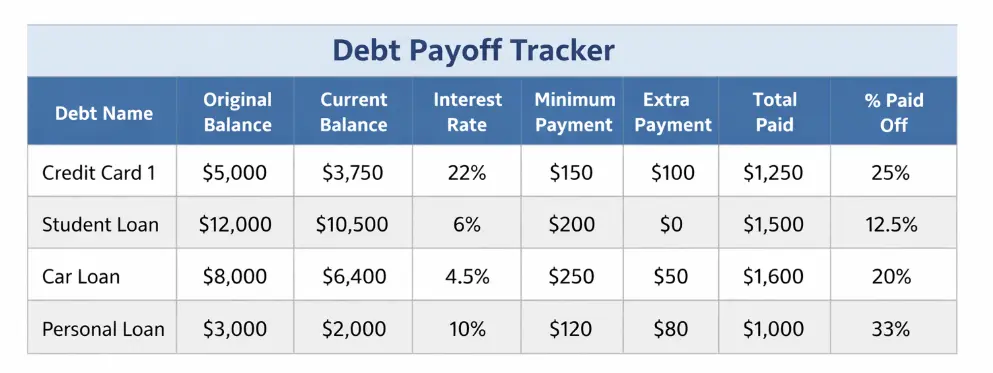
Before you can start slaying these financial dragons, you need to know exactly what you’re up against. This isn’t the fun part, but it’s crucial. Think of it as your pre-battle intelligence gathering. You need to list every single debt you have, no matter how small or seemingly insignificant.
Grab a pen, open a spreadsheet, or just pull up your credit card statements. We’re talking about getting down to the nitty-gritty details for each debt. This includes:
- Creditor Name: Who do you owe? (e.g., “Bank of Awesomeness Credit Card,” “Student Loan Co.”)
- Original Balance: How much did you start with? (Optional, but great for seeing the full journey!)
- Current Balance: The cold, hard number right now.
- Interest Rate: This is your enemy’s strength stat. Know it!
- Minimum Payment: What’s the bare minimum they expect?
- Due Date: When do you need to pay by?
Avalanche vs. Snowball: Choose Your Weapon
Once you have all your debts laid out, you’ll need a strategy. There are two main approaches, and both have their champions. Which one is right for you? It’s a personal choice, honestly.
- Debt Avalanche: This strategy focuses on paying off debts with the highest interest rates first, regardless of balance. Mathematically, it saves you the most money over time because you’re attacking the most expensive debt first. It’s smart, efficient, but sometimes takes longer to see a debt completely disappear.
- Debt Snowball: This method prioritizes paying off debts with the smallest balances first, regardless of interest rate. The idea here is psychological: you get quick “wins” as smaller debts are eliminated, which builds momentum and keeps you motivated. You might pay a bit more in interest overall, but the mental boost can be invaluable. There’s no wrong answer here. Pick the one that resonates most with your personality. If you’re a numbers person, go avalanche. If you need those quick wins to stay pumped, snowball it up!
Designing Your Debt-Slaying Masterpiece
Okay, you’ve got your intel. Now for the fun part: creating the tracker itself! This isn’t a one-size-fits-all situation. Your tracker should be as unique as your debt journey. Do you prefer digital dexterity or the tactile satisfaction of pen and paper?
Digital Dynamos: Spreadsheets & Apps
For the tech-savvy among us, a digital tracker offers incredible flexibility and automation. My personal favorite, IMO, is a well-designed spreadsheet. Google Sheets or Excel are your best friends here.
A basic spreadsheet setup might include columns for:
- Date: When did you make the payment?
- Debt Name: Which debt did you pay?
- Payment Amount: How much did you throw at it?
- New Balance: The updated, lower number!
- Total Paid to Date: A running tally of your contributions.
- Remaining Balance: How much more to go?
- Percentage Paid Off: This is a huge motivator!
You can even add conditional formatting to make cells change color as you get closer to zero, or create charts and graphs that visually represent your progress. There are also fantastic debt payoff apps out there that automate much of this, but sometimes the manual input of a spreadsheet makes the progress feel more real.
Tactile Triumphs: Whiteboards & Printables
If you’re more of a hands-on, visual learner, a physical tracker might be your jam. There’s something incredibly satisfying about physically coloring in a square or crossing off a number.
Consider these options:
- Whiteboard Warrior: Dedicate a whiteboard in your home. Draw a giant thermometer, a winding path, or a grid of squares representing chunks of your debt. As you pay, fill it in with a colorful marker. It’s right there, staring you down, reminding you of your goal.
- Notebook Ninja: A dedicated notebook can be simple yet effective. List your debts and manually update them. Add stickers, draw little celebratory doodles, or write encouraging notes to yourself.
- Printable Powerhouse: The internet is full of free printable debt payoff templates. Think debt thermometers, debt-free charts, or even “debt coloring books” where each section represents a chunk of money. Print one out, hang it on your fridge, and get to coloring! The key here is visibility. Put your tracker somewhere you’ll see it every single day. Make it impossible to ignore.
What Makes a Tracker Actually Motivating?
Simply listing numbers is a good start, but to truly make your tracker a motivational powerhouse, you need to infuse it with some personality and gamification. We’re talking about turning a chore into a triumph.
Visual Victory: This is probably the biggest one. Humans are visual creatures. Instead of just seeing “Balance: $5,000,” see a progress bar that’s 50% full, or a thermometer that’s halfway to “Debt Free!”
Progress Bars: Easy to implement in spreadsheets or draw on physical trackers.
Color-In Charts: Each square represents $100 or $1,000. Color it in when you pay that chunk.
Debt Thermometers: A classic for a reason. Watch that mercury rise!
Race Tracks: Draw a winding road. Each payment moves your little car closer to the finish line.
Milestone Mania: Don’t wait until you’re completely debt-free to celebrate. Break down your big goal into smaller, achievable milestones.
“First debt paid off!”
“Student loan below $10,000!”
When you hit a milestone, mark it clearly on your tracker. Maybe a star, a sticker, or a big, bold “WOOHOO!”
Non-Debt-Inducing Rewards: This is crucial. When you hit a milestone, give yourself a small, non-financial reward. We’re not talking about buying a new car!
A fancy coffee.
An hour to read a book, uninterrupted.
A movie night with snacks.
A long, hot bath.
A new plant for your desk.
These small treats reinforce the positive behavior without derailing your progress.
Personalization Power: Make your tracker yours. This isn’t a generic template; it’s your personal journey to financial freedom.
Add photos of what you’re saving for (a trip, a house, a new hobby).
Include inspiring quotes.
Use colors that make you happy.
Give your debts silly nicknames (e.g., “The Credit Card Kraken,” “The Student Loan Serpent”). It helps de-personalize them and makes them feel less intimidating.
Keeping the Momentum Going
Let’s be real, the debt payoff journey isn’t always sunshine and rainbows. There will be months where progress feels slow, unexpected expenses pop up, and you just want to throw in the towel. This is where your tracker becomes your anchor.
- Update Religiously: Make it a habit. Whether it’s weekly, bi-weekly, or monthly after your payments clear, commit to updating your tracker. Seeing those numbers shrink, even a little, is a powerful reminder of your effort. FYI, consistency is key.
- Review and Reflect: Don’t just update; actually *look* at your progress. How far have you come? What adjustments can you make? Did you overspend in one area? This isn’t about shame, it’s about learning and optimizing.
- Share Your Journey (Wisely): If you have a trusted friend, partner, or family member who supports your goals, share your tracker with them. Accountability is a powerful motivator. Just make sure it’s someone who will cheer you on, not judge you.
- Adjust, Don’t Abandon: Life happens. Sometimes you’ll have an emergency, or your income might fluctuate. If you need to pause extra payments or adjust your strategy, that’s okay! The goal isn’t perfection; it’s progress. Don’t ditch the whole plan because of a temporary setback. Just adjust and keep going.
FAQ: Your Burning Debt Tracker Questions Answered
How often should I update my debt payoff tracker?
This really depends on your preference and payment schedule. Many people find that updating it weekly or bi-weekly works best, especially if they’re making multiple payments or attacking a debt aggressively. If you only make one payment a month, then a monthly update after that payment clears is perfectly fine. The key is consistency, not frequency for frequency’s sake.
What if I miss a payment or go off track? Should I just give up on the tracker?
Absolutely not! Think of it like a GPS. If you take a wrong turn, you don’t throw the GPS out the window; you recalculate. Life happens, and financial setbacks are part of the journey. Simply update your tracker with the new numbers and adjust your plan moving forward. Don’t let a single misstep derail your entire effort. It’s a marathon, not a sprint.
Is it okay to have multiple trackers for different types of debt?
You bet! Some people prefer a single, overarching tracker for all their debts, while others like to have separate trackers for different categories, like one for credit cards and another for student loans. Do whatever makes the most sense to you and keeps you motivated. If breaking it down makes it feel less overwhelming, go for it!
What’s the absolute best tool to use for a debt payoff tracker?
The “best” tool is the one you’ll actually use consistently. For some, that’s a sophisticated Google Sheet with fancy formulas and charts. For others, it’s a simple pen and paper or a whiteboard on the fridge. Don’t get bogged down in finding the “perfect” tool; just pick one and start tracking. The act of tracking itself is more important than the specific medium.
Can I include savings goals on my debt payoff tracker?
While your primary debt payoff tracker should focus on debt, you can absolutely integrate savings goals into your overall financial tracking system. Some people create a “net worth” tracker that includes both debts (decreasing) and assets/savings (increasing). Just make sure your debt tracker remains clear and focused on its primary mission: getting those balances down to zero.
The Finish Line: You Got This!
Creating a debt payoff tracker isn’t just about crunching numbers; it’s about building a powerful tool for motivation, clarity, and control. It transforms an intimidating burden into a conquerable challenge. Every time you update it, every time you color in a square, you’re not just moving numbers around; you’re actively taking steps toward a future where you call the shots.
So, go forth, gather your debts, design your masterpiece, and start tracking your way to financial freedom. You’ve got this, and your future self will thank you for every single payment you log.
Want more simple, real-world money advice?
Join the Cash Clarity Finance newsletter and get clear, actionable tips to help you build your financial future.